


Sample approval is not a quality guarantee. It is a quality snapshot.
The bag a supplier sends for evaluation is drawn from a controlled production run prepared specifically for that purpose. It reflects what the manufacturer can produce under optimal conditions. What procurement teams at Canadian retail chains actually need to know is whether what arrives on the third reorder — produced as a routine batch alongside twenty other SKUs, with a different raw material lot, by a different shift — performs identically to what they approved.
In the compostable bag category, that question is harder to answer than it looks. Achieving compostable bag quality consistency OEM Canada requires a production system specifically built to manage bio-resin film and FSC-certified paper substrates — materials that behave differently from conventional polyethylene under production conditions: narrower temperature windows, greater sensitivity to humidity, more lot-to-lot variation in certified raw materials. Without a quality system built for these variables, batch drift is not an exception — it is an eventual certainty.
This article explains how Guarden's manufacturing and quality infrastructure delivers private label compostable bag reorder consistency specifically, and what that means for a retail buyer running a program at scale.
How Guarden's Dedicated OEM Lines Establish Compostable Bag Quality Consistency from the Start
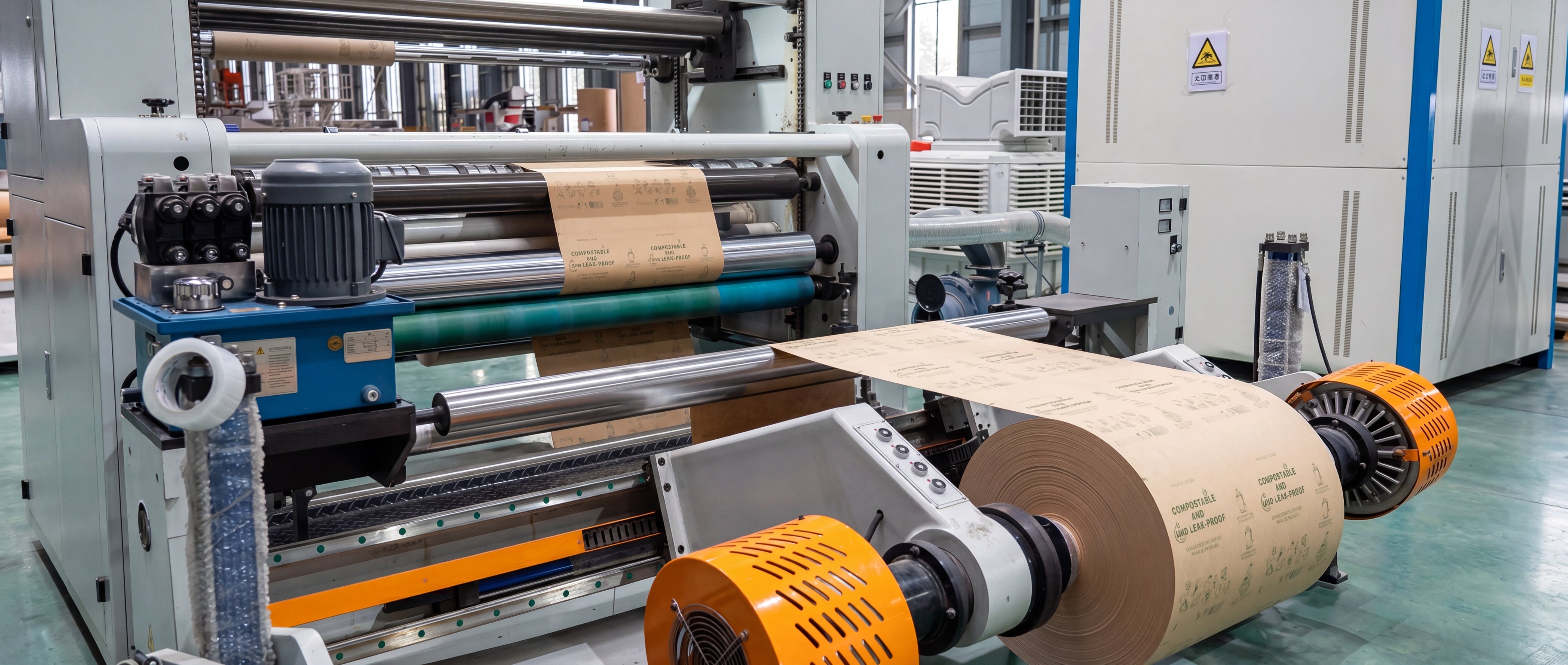
The starting point for compostable bag quality consistency OEM Canada is process isolation. Guarden operates multiple dedicated manufacturing lines built exclusively for compostable packaging — not shared with conventional plastic bag production.
This matters because bio-resin and FSC-certified paper substrates require different processing disciplines from standard polyethylene: specific temperature calibration ranges, controlled humidity in raw material handling and storage, and line cleaning protocols that prevent cross-contamination from residual conventional material. A production line that alternates between conventional and compostable materials cannot maintain the process discipline that certified compostable output requires.
Dedicated lines mean that the processing environment for every Guarden production run is consistent with the certified material being used — eliminating a common source of inter-batch variation that affects manufacturers running mixed production operations.
Batch Quality Control for Compostable Packaging: Leak, Load, and Puncture Testing on Every Production Run
Guarden's certified compostable bags supplier batch quality control system tests every production batch against three physical performance parameters before it ships. These are not laboratory tests conducted on prototype material at the product qualification stage. They are production-run tests, conducted on bags drawn from the actual batch, measured against the specification the buyer approved.
Leak resistance — 72-hour zero-seepage standard.Kitchen waste liners and bin liner bags are exposed to liquid organic waste in normal use. Seal integrity under liquid load is tested against 500ml over 72 hours at ambient temperature. Zero seepage is the pass threshold. A batch that does not meet this standard within Guarden's batch quality control compostable packaging system does not ship.
Static load capacity — tested to 10kg+.For paper bag products, structural integrity under the weight of a full organic waste load is tested with a 10kg+ static load applied to the handles and base construction. The bag must maintain full structural integrity — no handle separation, no base failure — under this load.
High-velocity puncture resistance — zero penetration.Organic waste contains hard, sharp materials: bones, shells, pits, broken items. Guarden's puncture test uses a corkscrew-style steel point dropped three consecutive times from 30cm height onto the bag base and wall. The verified result across Guarden's paper bag product line is zero penetration — no piercing of the multi-layer construction after three impacts.
Each test result is recorded against the specific production batch number, stays on file, and is retrievable for procurement audit. If a retail buyer receives a quality complaint on a specific shipment, the batch test record can be reviewed within the same business day. This is what certified compostable bags supplier batch quality control looks like in practice — not a quality declaration, but a retrievable test record tied to every shipment.
Supply Chain Traceability for Compostable Packaging: How Guarden Links Every Retail Shipment Back to Its Raw Material Origin
Batch testing tells you whether a finished product met the performance specification. Supply chain traceability compostable packaging retail programs require tells you why — and makes it possible to isolate and resolve quality variation when it occurs.
Guarden's production records link every finished batch to its specific raw material inputs: the certified resin lot used in film production, the FSC-certified kraft paper substrate batch, and the barrier coating applied in the paper bag construction. This supply chain traceability compostable packaging retail documentation chain runs from certified material origin through production batch to the export shipment.
The operational consequence of this structure: any performance variation detected in batch testing — or reported from the field after delivery — can be immediately traced to the input variables of the specific production run involved. If a deviation is traceable to a specific raw material lot, that lot can be isolated. If it is traceable to a processing parameter, the parameter record identifies when and how it deviated.
For retail procurement teams with vendor compliance requirements or ESG reporting obligations that reference supply chain traceability, this documentation is retrievable on request — not reconstructed after the fact.
Private Label Compostable Bag Reorder Consistency: Guarden's Production Specification Lock System
The mechanism that translates batch testing and traceability into private label compostable bag reorder consistency is the production specification record maintained for each approved SKU.
When a buyer approves a product through Guarden's sample process, the production parameters that generated that sample are documented: film thickness tolerances, sealing temperature range, barrier coating specification, print parameters, dimensional tolerances, and the performance test thresholds against which that configuration is validated. That specification is locked against the SKU.
Every subsequent reorder is produced against the locked specification. Batch test results are compared against the same thresholds used at original approval. If incoming raw material lot variation requires a processing parameter adjustment to maintain output within specification, that adjustment is made and recorded — the output target remains unchanged.
This is what makes the fifth reorder match the first. Not the supplier's intention to produce consistent product, but a documented system that defines what consistent means for that specific SKU and tests every batch against it. Private label compostable bag reorder consistency is the outcome of this system — not a promise.
PFAS-Free Compostable Bag Manufacturer Documentation: What Retail Vendor Onboarding Now Requires
For programs distributing kitchen waste liners or produce bags, PFAS-free compostable bag manufacturer OEM documentation is a growing requirement in Canadian retail vendor onboarding — particularly for food-contact SKUs.
PFAS (per- and polyfluoroalkyl substances) are synthetic chemicals formerly used in paper packaging for grease and moisture resistance. Their persistence in the environment and links to health concerns have made PFAS-free test documentation a standard procurement requirement for any paper-based compostable bag in food-contact applications.
Guarden provides PFAS-free compostable bag manufacturer OEM test documentation as part of the standard compliance package. Documentation covers both the paper substrate and the barrier coating applied in production — the two inputs most commonly flagged in retail vendor audits. Procurement teams do not need to request this separately; it is included with the standard shipment documentation package.
What This Means for a Private-Label Retail Program
A Canadian grocery or retail chain running a private-label compostable bag program is putting its own brand on a product whose performance is visible to consumers every time they use it. A kitchen waste liner that leaks on the third month of distribution generates a consumer complaint that reads as a failure of the retailer's own brand — not of an upstream supplier.
Guarden's quality infrastructure — dedicated OEM production lines, batch quality control compostable packaging testing on every run, supply chain traceability compostable packaging retail documentation, production specification lock for private label compostable bag reorder consistency, and PFAS-free compostable bag manufacturer OEM records — is built to prevent that outcome across the full program lifecycle, not just at launch.
Batch quality records, traceability documentation, and PFAS-free test reports are provided as part of standard shipment documentation — not as a supplementary request. Retail partners who need to respond to a procurement audit, a vendor review, or a field quality report have the full documentation package available without a delay cycle.
Share:
BPI Certification and Compostable Packaging Documentation for Canadian Retail Buyers
Compostable Bag Certification in Canada: What Retail Buyers Need to Know Before Sourcing